Showing posts with label Rant. Show all posts

Sunday, June 20, 2010

If I had a hammer

Suppose I asked you to join two pieces of wood, two 2 by 4's, three feet long.  I need you to join the boards at each end and in the middle.  I give you a hammer and you walk to the right end of the boards where you find a nail already started.  Somewhat tentatively you take several swings before finally driving the nail in.

You take a step to the left and at the mid-point of the boards you find another nail.  More confidently, you take a couple of really good swings and drive the nail home. Finally, you take another step to the left and at the left end of the board you find ..... a screw.

My question to you is a simple one. Is the hammer broken?

The obvious answer is no and most people would be smart enough to either get a screwdriver or replace the screw with a nail. A few truly creative, out-of-the-box thinkers, such as myself, would simply pound in the screw with the hammer, although I don't recommend it for finish work.  (Oh please, that revelation didn't really surprise you, did it?)

Still, there are those that must bring work to a complete halt so they may blame the task master, the hammer, the screw or the over-reaching federal government seeking to nationalize the construction industry. 

It is this question, is the hammer broken, that I come back to again and again as the battle over educational reform rages on.  For far too many people, the current educational system can't merely be a tool that successfully met the challenges of the past, but is not design to meet our new requirements.  It must be broken and someone must be to blame.  However, as Gerry Weinberg reminds us in his wonderful book The Secrets of Consulting:
The chances of solving a problem decline the closer you get to finding out who was the cause of the problem.  (Spark's Law of Problem Solution)
The challenge then, is for us interested in the education of the IT professionals of the future to wade into the debate with our required outcomes in hand.  We must continue to press for a discussion of the what and why of education, while steadfastly refusing to be drawn into the debate of how and who.  Most of all, we must resist the temptation to play the blame game.

Saturday, August 8, 2009

Giving them the first degree

So here is the story, about a year ago a group of 10 Washington State Patrol (WSP) troopers were accused of having received college diplomas from questionable institutions (i.e., a degree mill). Troopers, you see, get 2% pay increase for earning a 2 year associates degree and a 4% increase for earning a 4 year bachelors degree (what a coincidence that the percent pay increase matches the number of years in the degree). An investigation last winter indicated that they had received some basic approval from the human resources staff and would, therefore, not be prosecuted for criminal offenses. In just the last couple of days, however, the WSP has recommend firing the 8 individuals remaining on the force. [go here to find a list of articles in Puget Sound media outlets covering the story.]

How did this all come to light? No doubt it was because of their sub-par performance when compared to troopers with legitimate degrees, right? No, of course not. A degree mill in Eastern Washington was busted and it served government employees, so they worked back through the list of employee degrees (ah, the old employee-degree table) and there are your alleged cheaters.

Does that make you upset at the troopers? Not me. The troopers want to earn more money - who doesn't - and the best way to do it is to get a degree. Their employer doesn't really seem to care if it is a legit degree and since there doesn't appear to be a direct relationship between degree and job performance why kill yourself. That is, unless you like school.

What drives me crazy is that their employer, my government, gives out pay increases for things that should eventually lead to better performance, instead of for the performance improvement itself. I mean, if the degree really makes a difference then it should show up in the individual's performance, right? And, if their performance improves without a degree, shouldn't they get a raise too?

It might be useful to ask ourselves what we really want when we make a college degree a requirement for employment (or for a pay raise). I think what we expect is that the degree certifies that a person has gained a set of skills, knowledge, experiences and personal connections that we feel makes for a "better" person. Great, but what if it doesn't? A degree is normally granted based upon the accumulation of credit hours from a disparate set of general studies and program specific classes. I never had an assessment to determined I was a good critical thinker, did you? I am sure, however, that there are those who think my time on the banks of the Mountlake Cut ensure that I am.

Worse still, by requiring a degree in addition to the skills/knowledge/experiences we specifically exclude individuals who can demonstrate they have gained those skills/knowledge/experiences through means that didn't lead to the granting of a degree. It sends the clear and unmistakable message that acquiring a piece of paper that says we know something is more important than knowing something. Why are we surprised that we end up with degree mills, people buying term papers and lying on resumes?

I fear we are creating a college degree bubble that will, like housing and tech stock bubbles before it, burst leaving us worse off, both individually and as a society. Student loan debt is just the first and most obvious sign of trouble ahead. Post-secondary education is an absolutely vital part of our society, but the ascendancy of the degree to near deity status is making the system weaker, not stronger. The challenge is for employers, public and private, to back away from the edge of this cliff.

Postscript: On August 30th James McCusker, the economics columnist for the Everett Herald, wrote a column titled "Focus on skill, not school, for hiring". In it he takes on the "relentless marketing of academic credentials as a product". He suggests that we need to focus on the real requirements of the job and not add unnecessary educational requirements simply to reduce the pool of applicants. The article is right on the mark and well worth the 5 minutes you'll spend reading it.

Technorati Tags: , ,

Sunday, April 5, 2009

A little piece of americana

Our friend Tim holds concerts of local and visiting musicians in his home 4 times a year. The musicians usually play the didgeridoo, but occasionally they play other instruments associated with the aboriginal people of this continent. A couple of weeks ago we had the opportunity to see Tyler Spencer playing with Shireen Amini like they did in this video from the 2008 Seattle World Rhythm festival.

Shireen played a song that was inspired by watching her cousins as they were updating their social networking pages, text messaging and watching MTV all at the same time. She remarked at being both fascinated and horrified. They were consuming snippets of culture instead of participating in a sustained creative process. They lacked an outlet to guide and encourage inherent creativity.

Shireen highlighted a program called the Americana Project at the Sisters (OR) School District. Students learn to play, write, perform and record. To date, they have released 7 CDs of music created, performed and engineered by the students. I have to think that programs like the Americana Project encourage the passion for creativity while keeping students engaged in school.

In the book "First Break All the Rules" the authors tell us that the best managers don't focus on overcoming an employee's weaknesses, but instead maximizing their strengths and talents. We also learn that the best organizations have staff that consistently answers the question "Do I have an opportunity to do what I do best everyday" in the affirmative.

If it works for creating excellence in the workplace, why not the education setting? As we work to address a 30% high school drop out rate, we might want to ask ourselves if these types of programs will help students to get engaged and stay engaged in school? We might still further ask ourselves if we can expand these types of programs beyond just music or athletics? Other specialized programs, like those at the Sno-Isle Tech Skills Center, are seen as a place to go if you're not good at school (it's not true, but is the perspective of some). Why? Why is the desired to be a great gymnast or saxophonist a good thing and a great welder a bad thing? Some one's got to be the Wynton Marsalis of welding, why not your kid?

Tags: , , , ,

Monday, January 19, 2009

Snow Day 2.0

Aggggggggggggggggggggggggggggggggggggggggggggggggggggggh! Please tell me we aren't discussing how to make up snow days, again. Please tell me the anti-teacher crowd isn't using the snow day issue to extract a pound of flesh from instructors, again.

With planning and proper application of technology there is no reason for missed days due to snow. Education should not be dependent on one's presence in the classroom. I mean seriously, home school kids learn at home everyday for decades, why can't your kids do it for 3 days every other year? The answer, of course, is that that they can. Unfortunately, we have codified "days in class" as an absolutely essential deliverable from schools. (Pop Quiz: What other state institution uses "time served" as the primary measure of success?)

As a taxpayer and hiring manager, I am far more concerned with student achievement than I am with student attendance. Days in class reinforces an incorrect notation of education as a place-bound, time-constrained process; the academic equivalent of the auto assembly line. In the modern workplace, at least for technology and information workers, what you get done is far more important than when and where you do that work. (In this context, when refers to your working hours, not whether you deliver on time. That still matters a lot.)

Make-up days are sensible if every moment in class is packed with critical information. But are they really? Let's say you have a daughter at Jackson High and class is canceled 3 times in January. That means she'll have 3 more hours of history class in June. What exactly do you think she is going to learn in that 3 hours that will make a difference in her life, career or education? What, did you think teacher was going to forget to mention that the North won the war?

One of the key underlying themes to this blog is that significant reform to the educational system requires participation from those of us outside the process as well those on the inside. If we want to stop the whole snow day thing, then it is going to be up to those of us outside the process to ask our political leaders and the Office of Superintendent of Public Instruction (OSPI) to change the law first. When the law is changed, then and only then, can local school districts and teachers create plans for Learn From Home days; the educational equivalent of Work From Home.

Tag: ,

Saturday, January 17, 2009

Self-funded University - Take 2

Well the reaction to the proposal to pay for our own university and my blog post are pouring in. There are too many to count, assuming you haven't learn to count to 3. But hey, it's just the future of post-secondary education in our community. It's not like there is a barista in Maltby making coffee in her underwear. [Seriously, compare the number of letters to the editor in the Everett Herald discussing barista attaire vs the university. Some days it's easier to believe in the wisdom of crowds than others.]

Two of the three comments are skeptical of the idea of a local entity building a State facility, one from an anonymous commenter in a previous post and one via Facebook from Kevin. Very legitimate questions about the nature of funding. If Snohomish County funds the university construction how would it transfer to the state, or would it? Would the State fund the operations of the school or not? Would the State subsidize the tuition of students as they do at the other universities or would Snohomish county (or would there be no subsidy so that costs were comparable to other private institutions)? Here is what Kevin had to say:
Interesting idea. Not sure it takes into account the notion of distributing state funding (such as there is) to meet needs across the state or why one county should try to shoulder that budget burden on its own when others clearly don't have to. As a trend it would likely lead to more education resources showing up in wealthy counties (those who can afford to, do, those who can't, don't) and fewer in poor counties?
Kevin is intimately familiar with the funding process in post-secondary education and I take his comments seriously. My response brings me back to the same basic concept - the State doesn't need to build a brand new university complex from the ground up to meet the State's education needs. Further, the citizens of Kitsap County, Vancouver and the Tri-Cities would argue that the State's needs could be better met by spending a $1 billion in construction in their jurisdication. The commute from Poulsbo to Bellingham is longer than from Marysville.

If, as is often stated by proponents for the Snohomish county location, a new university will be a significant economic benefit then the citizens receiving that benefit should have some skin in the game. And let's face it, a world-class polytechnic university focused on graduate and post-graduate studies in science, technology, engineering and math (STEM) isn't going to meet the educational needs of most of our citizen's. It's meant to encourage new businesses and job growth in high-tech fields and the student population will be largely from out of the area (probably out of the country).

The other comment I saw was a letter to the editor in the Herald by Douglas Russell. His comments went directly to the heart of my "put up or shut up" commnet in the original post. Mr. Russell "put up", suggesting that he is more than willing to pay for the educational and economic benefit we would receive from a university, for his children and for his community.
The idea is that I can have a four-year college in my back yard, with a curriculum decided on by the community, based on the needs of the community, employing hundreds of faculty and staff, enrolling hundreds and hundreds of local students, and all I need to do is go to a store and hand the cashier an extra 10 cents the next time I drop $50 on purchases. I've got a dime right here, sign me up.
I am far more impressed by Mr. Russell's commitment of his limited time and money than anything Haugen, Dunshee and Sells have said in the last two years.

Yet, even in his letter we see the disconnect that our civic and political leaders have cultivated throughout this process. Mr Russell asks our leaders "Educate us. Show us how this will work, how we can bring jobs and families back to our community and how we can make a difference in the lives of our children". The sole focus of our leaders, however, has been on construction sites and construction dollars. They have demonstrated beyond a shadow of a doubt that they would rather have no university than to have it in the "wrong" city. Further, Mr. Russell is excited about a "curriculum decided on by the community" and not sending his kids off to the U District. Unfortunately, this is planned to be a polytechnic university, so unless all his kids will be studying STEM they may well be living in the U District. Mr. Russell deserves an answer from our leaders. We all do.

So good residents of Snohomish county, what do you think? Willing to pay extra for a local university? If not, why should residents of Bremerton, Richland and Vancouver pay for a university in our county? Should it be another broad-curriculum school or a highly-focused technical school? Should it meet the broad educational needs of our county's citizens or should it's primary purpose be to encourage economic growth and development?

Tags: ,

Thursday, January 1, 2009

Stimulus Spending

So what's your "elevator pitch" to President-elect Obama on stimulus spending for education? What do you say when then the President-elect steps into elevator with you, presses the button for the 47th floor and asks "how would you spend $40 billion on education so that it boosts employment immediately and enhances education in the long run"?

The Edmonds Community College (EdCC) newsfeed and twitter feed highlighted an op-ed from USA Today that said don't forget the critically important role that CC's play in the education of our society. Their concern stems from a set of 2-page ads by a group of major universities calling on the incoming administration to spend 5% of the stimulus package on education and "shovel-ready" projects at the universities. USA Today is right to call for that money to be shared more equitably with the CC's.

A quick search of the web turned up an Inside Higher Ed article on the topic including separate statements from the American Council on Education and a coalition of universities, plus some rather strong contrarian views that higher-ed doesn't deserve the money without strings attached (like the car companies). And to round out the spend-fest, this USA Today article discusses the stimulus spending that might go to K-12 education.

So here are the 5 points I'll make on the elevator with Barack:
  • Fiber optics are the new concrete. Our fascination with buildings and roads is a decidedly 20th century preoccupation. We need to spend less (not $0, however) on buildings and more on broadband, data centers, learning management systems and business intelligence.
  • World class K-12 education is the foundation. Money should first be spent on K-12, then community college and finally on 4-year universities. Sorry, but the number of people not getting a great high school education is far more concerning to me than people not getting to go to college right after high school. Bill Gates received a great high school education and part of a great college education - take a lesson.
  • Create computer-ready jobs too. Why are we preoccupied with creating construction jobs all of a sudden. How about an IT Corp that paid for unemployed IT professionals to work in school IT departments for 2 years? Or perhaps a Online Ed Corp, where unemployed educators would not teach, but focus entirely on the migration of existing in-class curriculum to an effective online format?
  • Education for the educators. You can't just throw computers at teachers and say "here, do something useful with them". The internet and collaborative tools make the situation even worse. Teachers need to rethink everything to turn a good on-site class into a good online class. We need to spend money revamping teacher education and we need to send existing teachers back through the system (they can become part of the Online Ed Corp mentioned above).
  • Learning starts when education ends. In a world where continuous personal and professional education will be the norm, we need to stop focusing on degrees and start focusing on learning. We need to pay attention to libraries and librarians (see this ALA statement on stimulus spending). I'd like to see a few tens of million go to turning Suzzallo into the physical hub of Washington's virtual Library of Alexandria.
Oh, this is my floor. Nice talking to you.

Technorati Tags: , , , , , , , ,

Tuesday, December 30, 2008

The Sno Poly Fighting Ailerons

Saturday's Everett Herald featured a story by political writer Jerry Cornfield on the possiblity of Snohomish County funding its own University. Sen. Steve Hobbs is introducing legislation to create a higher education investment district to fund the creation of the 4-year Polytechnic university. Funding would come from bonds that would be repaid with the proceeds from a .02% sales tax increase in areas participating in the investment district. Newly elected Rep. Mike Hope is sponsoring a companion bill in the House.

I am no fan of the proposed university - it funnels money from education to construction - but I really like this proposal because it gives the citizens a chance to indicate how important the college is to them. Hobbs is quoted as saying "Now this says to the community 'if you really want it, here is an opportunity and if you don't want it, we'll move on.' " Let me summarize:
Snohomish County, put up or shut up.
Let's face it, up to now we have had no skin in the game. All the benefits come to us and all the costs are paid by someone else. What a deal! But that's not how life should work. When we break the feedback loop, when benefits aren't balanced against costs, we create a situation where really poor decisions are made (like when people who make mortgages are insulated from the negative effects of the loans going bad).

Under the Hobbs proposal residents of Snohomish county can vote to raise their own sales tax and commit the money to paying off $400 million in bonds. That is what I call putting your money where your mouth is. In addition, the proposal seems to put a stake in the ground and definatively state that this will be a polytechnic university. No waffling, no leaving open the possibility of an art history degree. Knowing it will be a science, technology, engineering and math (STEM) focused school will also help voters decide if the proposed university will fill their needs for post-secondary education.

If my fellow citizens voted to tax themselves to build a polytechnic university I would get behind the effort. I might even go for a Master's in Computer Science (Mrs. AdvisoryBored's MS is making my BA feel inferior). Still there is plenty in the article to make me doubt the university will ever come to fruition:
  • Aaron Reardon heaps blame on the state for not doing it's job to build a college, but it was us that couldn't choose a site. If the three musketeers (stooges?) - Haugen, Sells, Dunshee - couldn't come to some agreement over the course of 18-months and with the help of a mediator, why do you think they will put their bickering aside now?
  • Mike Sells doesn't think the idea will get much "traction", but it deserves a hearing. A hearing in front of the committee where he is Vice-Chairman. If it doesn't get much traction it will because Sells doesn't want it to get much traction.
  • It is questionable if this school will be able to meet any significant portion of the demand for post-secondary education by our county's citizens. While half of the slots might be allocated to local students, there is a very really possibility that local students won't be interested in or prepared for STEM-focused programs. Backers have consistently described these as "high demand programs", but they refused to acknowledge that students have not been enrolling in these programs for years. Everyone needs to understand up front that this school's population may largely be young men from other parts of this country or world.
In the meantime, let's look towards Central, Western, EdCC and EvCC (including University Center) to keep delivering the goods.

Technorati Tags: , , , , , ,

Wednesday, December 17, 2008

Connections yes, funding no

Today's Everett Herald had an interesting editorial piece on education. To summarize: there are a lot of good, high-skilled, high-wage jobs out there, but students aren't aware and aren't preparing for them. The solution is a $900 million fund for grants to help draw the connections.

Okay, I'm buying the part about good jobs. I agree that students aren't recognizing the full range of career opportunities. The drop-out rate is way too high, yes I'm with you. So we need a new federal program to make grants. Oppps, you lost me on that last one.

Is it possible that students don't see these as an option because we - parents, teachers, counselors, business leaders, politicians and editorial writers - have spent the last 30 years devaluing these careers? I've done it myself. I've joked about avoiding jobs where your name is sewn on your shirt. Never mind that for the last 20 years I've been sporting a badge that tracks my every moment and features a picture that makes my driver's license photo look like Annie Leibovitz was working the camera at the DMV.

A month ago I walked into the Mariner High counseling center for our first advisory committee of the year. What I saw were big banners with the registration dates for the major public and private 4-year colleges in the area. That's all I remember seeing. There may have been information on community colleges and apprenticeship programs, but I sure don't remember them. If it made that big of an impression on a 50-year old, imagine the message a 15-year old receives.

I have heard on several occassions, from teachers in different districts, that counseling students to options other than a 4-year degree directly following high school is not done. The expectation is that college is the one true way to succeed in life. Society sees it that way, why shouldn't counselors. You've heard administrators proudly claim that "xx% of our graduates are accepted to 4 year colleges"? Okay, again why are students not looking at the full range of career options? Is it possible that students are listening to what we are saying, even if we aren't listening to ourselves?

So yes, we do need to feature these career paths. Yes, we do need to counsel students about their options. Yes, we do need to celebrate the opportunity Sno-Isle Skills center and our community colleges offer. We don't need a federal program and grants to do it. We've put up a wall to block student's view and now we want a federal grant to install a window. It's our wall and we should remove it ourselves.

For related discussions, see my 2+2+2 = Bachelor of Applied Science and Review Rep. Loomis Wrap Newsletter posts.

Tags: , ,

Santa arrives on a Viking ship

Christmas came early this year for fans of post-secondary education when Western Washington University announced two new bachelor's degree and one new master's degree to be offered at Everett Community College's (EvCC) University Center. If that weren't enough, the Herald's Editorial Board, in this Sunday's editorial, finally seems to acknowledge the value that University Center can bring to the county. I wished I had thought of that (oh wait, I did).

It's a nice change of pace from the news on post-secondary education we received this summer and into the fall. Our political leaders just embarrassed themselves arguing over the location, demonstrating to all that construction dollars, not education is their primary goal. Then a mediator was assigned to help break the impasse, but without much luck. Then the economy and the State's tax revenue tanked. As a result, expect staff cuts, program elimination, enrollment reduction and cost increases at every single public university and college in the State. The topping on the sundae is Sen. Shin's being replaced on the Higher Ed committee by a member from Gig Harbor. Did you know they want a UW branch campus out on the peninsula? Seems they're like the second biggest county in the State without a university and it would bring technology jobs and yada, yada, yada.

Look, I'm not suggesting that we don't need more educational opportunity in the tri-county region, far from it. I am, however, suggesting that a new university focused on advanced science, technology, engineering and math (STEM) degrees won't help most people, and my quite possibly make the situation worse. Here are the questions I am asking when I read about the proposed university:
  • Has anyone stated for a fact exactly what type of university this will be? Will it be WWU or UW or MIT? Isn't that a more important decision than where it should be located?
  • How will it help lower high school and/or college drop out rates?
  • How will it help lower the cost of education, consistent identified as the biggest barrier to students attaining their goals?
  • How will it help prepare high school students for, and encourage them to enter, STEM programs in college?
  • How will it help students who need more learning opportunities, but who do not thrive in an academic environment?
  • How will it help address the need for continuing education required to advance in a career or switch careers through a person's working life (it isn't called the Information Age for nothing)?
All I know is that no matter what the problem is, a UW branch campus will fix it. It's like educational cod liver oil. So, until the proposal starts answering these questions I am completely opposed to this construction initiative. More thoughts are available on my archived No Sno U blog and I keep a list of Delicious links tagged UWBranch that you can view.

Tags: , , , , ,

Tuesday, November 25, 2008

Silk Degrees

From yesterday's (11/24/08) Everett Herald comes an article on the expansion of degree offerings from other universities as the UW branch campus idea dies a quick, painful death as a result of the State's budget shortfall.
As the campaign to bring a University of Washington campus to Snohomish County stalls, the state's other public universities are quietly expanding bachelor's and master's degree programs in the Everett area.
Quietly expanding? Really? Too bad Herald reporters don't read the ads in the Herald 'cause if they did they would know that the schools had been paying a lot of money to make the expansion of the programs broadly known. It's also too bad that Herald reporters don't read Herald letters to the editors 'cause if they did they would have seen a letter from me on 3/14/08 highlighting those same degree programs (you can also find the text of that letter here). I would argue that had the Herald not abandoned all journalistic integrity to become the primary cheerleader for the UW branch campus, the expansion of these programs would have been anything but quiet.

From my perspective as a lowly taxpayer these programs are a bargain because the deliver education to under-served populations, often in under-served areas, with significantly less infrastructure and administrative costs. A UW North Sound, for instance, will take the better part of a billion dollars and years of construction before we graduated anyone. These alternative from existing universities go up much faster (although they are still too slow to respond).

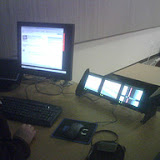
Take the Central Washington University (CWU) information technology and administrative management (ITAM) degree, mentioned in the article. You may recall that I blogged about the local version, a bachelor's of applied science ITAM (BAS-ITAM), last spring. The Herald article doesn't fully describe the value of the program. Yes it offers an IT bachelor's degree locally, but more important, it offers it in multiple locations and to a different student base. The program is taught simultaneously through distance learning technologies at Edmonds CC, Highline CC and now Everett CC. (Below is picture of the lecturer's workstation at Highline. The small screens let the lecturer see the classroom and students at the other locations.)

Lecturer Workstation

In addition, the program is targeted at a different audience than the Ellensburg-based ITAM degree. The BAS-ITAM is a two-year program for students that have completed an IT program at a community college and have at least a year of work experience (hence the "applied" part of the name). I won't cover the same ground covered in the earlier post, but one point bears repeating. Most community college IT programs are Prof/Tech and their credits do not transfer to any bachelor's programs (they are referred to as terminal degrees). Without the BAS-ITAM these students would have to start over again as freshman, spending time and money on areas of study where they already have the requisite knowledge. And, since the tuition is subsidized by the State, the program saves the taxpayers two years of tuition subsidy.

Also worth noting is that June 2008 saw the first set of graduates from the Edmonds and Highline locations. So CWU isn't really "testing the waters in Everett" as the article states.

For more ranting on what's wrong with a UW branch campus see my No Sno U blog.

Tags: , , , , ,

Thursday, November 13, 2008

Virtual High School

Did you catch the Monday edition of the Herald? Their lead article was about the growth in attendance in virtual (0nline) high schools.
Online schools are booming. In Washington, the number of elementary, middle and high school students enrolled full-time in public, online schools has nearly quadrupled in three years to 5,666 last school year.

Nationwide, the number of students enrolled in online schools jumped 60 percent, to 506,950 between 2003 and 2005, the latest year with data, according to the U.S. Department of Education.

Of course the paper edition had to feature more prominently the quote "I don't have to listen to teachers tell me what to do. This way I can site in my pajamas and still get it done." by putting it in a sidebar. That should stir some excitement in the if-it-was-good enough-for-me crowd.

It's time that education as a production line comes to an end. Students are not the raw materials of the education system and teachers are not factory workers, bolting facts onto students like an auto worker mounting a tire on a Buick. Is virtual high school part of solution?

Students don't all learn the same. People have different needs for the delivery of education. It's not that we have to do away with the existing format. Some people thrive in it, and it should continue. Many others don't, and we need an alternative for them. We can't afford to let students fail simply because we only want to teach one way. Perhaps you remember the TED Talks video from Ken Robinson titled "Do Schools Kill Creativity?" that I featured in a previous post. Take 20 minutes to listen Robinson's story of Gillian Lynne failing in the traditional school setting.

I know that we who serve on advisory boards are suppose to be thinking about about the needs of specific programs, but it seems to me that we also need to be thinking about the broader educational system. I'm interested in your thoughts. What type of people do you think would benefit from this alternative? Would an online education help prepare students for your job openings? Would you have wanted your high school experience to be all online, all in-class or some sort of hybrid?

Tags: , , ,

Sunday, November 9, 2008

I went to school board with 27 Jennifers

Jennifer at the injenuity blog has been reassessing the way she is presenting social media tools to teachers in her post About Face. The core of her message is that social media tools aren't necessarily right for all instructors. Forcing a set of tools upon an instructor does not mean better education. Unless teaching changes, the introduction of new tools does nothing to further the goal of better education.

Initially I wasn't really buying Jennifer's thought process (also see comments by Geoff Cain and a post from another author titled "Which Technologies Shall We Evangelize"). As I continued to read and re-read her post, I started to get her point about changing teaching. She says that:
Teaching has to change before these tools can be effective for learning. When we promote the tools to instructors who are using inappropriate instructional and assessment strategies, we are doing nothing to further the cause of learner-centered pedagogy and collaborative learning.
Still, if educators have not used social media tools, save a two-hour seminar in the summer, how will they ever participate in changing teaching. It may not be about the tools, but the transformation isn't going to happen without them either (or without teachers understanding of them).

It's no different in the business world. When I try to convince my co-workers on the business side of the house to use a wiki I get blank stares. "What does it do?" they ask me. Their mental model is of a software application designed for a specific task. Responding with "It's a tool to quickly develop and maintain knowledge repositories in a highly collaborative environment" doesn't resonate with them. I won't describe the look of disappointment when I say there isn't a manual. Until someone from the business side embraces the wiki, I'm stuck.

I hope that the instructors who are deterred from using social media tools by Jennifer's frank and honest discussion are only deterred from using them as a cornerstone of their current courses. My experience is that you need to embrace the tools before you can assess their value (or lack thereof). Teachers can adopt the tools as part of their personal life or professional development activities. And so what if you just use these tools to "pave cow paths". We used computers to cut paychecks for decades before we learned to send email alerts notifying you that you're about to reach your credit limit.

Instead of creating a flat classroom right out of the gate, perhaps they could start using a social bookmarking tool like Diigo or del.icio.us with a group of fellow instructors. Everyone needs to save bookmarks in such a way that they are available from any computer. Along the way the instructors will be introduced to tagging and the power of the network to deliver a high-value information resources (see Week 2 of Work Literacy's Web 2.0 for Learning Professionals for a better introduction to social bookmarking).

Tags: , , , , ,

Sunday, September 21, 2008

Bates and switch

The Tacoma News Tribune reports that Bates Technical College has agreed to pay $500,000 to settle a lawsuit by 16 former civil engineering technician students who claimed they were not adequately prepared for jobs in the field. This follows similar settlements with students in their court reporting ($170,000) and denturist ($1,250,000) programs.

Bates is one of five technical colleges in the State's technical and community college system. So when they say they agreed to pay, I'm guessing they mean that they agreed for us (taxpayers) to pay.

The take-away here is not that technical and community colleges are bad and that all students should instead get a bachelors degree from the University of Washington at Lake Wobegon (where all the children are above average). The take-away is that the goal of professional/technical (prof/tech) programs is to train "employable" students and if graduates aren't qualified, then the program is a failure. Here is what one student said:

“When I left Bates, I was embarrassingly not ready for work in the field and was told as much by employers and potential employers,” plaintiff Michael Edmundson wrote in an affidavit filed earlier this month. “Bates did not teach me how to use the equipment required by the industry or how to do the basic task required as an entry-level employee in the field.”
Having served 7 years on a prof/tech advisory board at a community college, and having left a little frustrated by the experience, let me toss out a few rough ideas for your consideration (instructors, administrators and general community)
  1. Program outcomes must be created with input from, and regularly validated by, an advisory board of working professionals. Advisory boards should be coordinated by the college as a function of Workforce Development (or equivalent), not the individual department. The composition and functioning of prof/tech advisory boards must be actively managed and not left up to chance.
  2. Prof/Tech programs are not the same as academic programs and instructors should not be granted the same academic freedoms. This is not to say that we should micro-managed every classroom decision, but instructors need to be teaching to agreed upon outcomes. Further, if those outcomes are not being achieved then corrective action needs to be taken swiftly for the students' sake. It's not okay for a prof/tech instructor to have a "bad" year. It's one thing for an AA to graduate without a full appreciation of Maslow's self-actualization level and another for a database administration student to graduate not understanding the importance of indexing in database performance.
  3. Instructors should be expected to hold professional certifications in their area of instruction and be able to demonstrate that their understanding of the field is current. I would suggest a regular sabbatical (every five years) to work in the field or, better yet, local businesses (the college itself) could hire instructors for ongoing project or part-time work. And if no one wants to hire the instructor, well I guess that tells us something too.
  4. We need to pay instructors enough to leave industry and teach. If database administrators (DBAs) routinely make $120,000/year then you are going to be paying around $120,000 to get a DBA instructor. I don't care what Sociology instructors with 25 years experience make. As an alternative, we could use part-time instructors so they could keep their regular jobs. In this scenario the college would need to invest in a person or persons who can focus on curriculum development and assessment while part-time instructors focus completely on classroom work and sharing experience.
  5. Businesses need to invest in the system by having top people - people who really understand the profession and its future - serving on advisory boards. I mean an active strategy of identifying and rewarding employees to participate.

Tags: , ,

Saturday, September 13, 2008

Yeah, I knew 2.0

Over at that the Dangerously Irrelevant blog Scott McLeod posted about engaging the broader community - local folks he called them - in a discussion of the revolution in 21st century teaching-learning. I couldn't agree more and I should know, I'm local folks. I don't teach or administer anything and I am not a parent. I suppose serving on advisory boards for technology programs at a couple of different school districts (and blogging about it) makes me a little different than average "local folks". Nevertheless, the revolution won't be happening without me.

If you read the edubloggers enough you will eventually find a post lamenting the hard work changing the educational system one teacher/administrator at a time. My response is always the same - converting teachers is only one essential part of the puzzle. The revolution of 21st century teaching-learning is a part of a larger transformation of the society (information revolution, death of mass). Transformation of the part cannot be done without transformation of the whole.

As a result, the broader community will need to be included in the conversation. Not only must we rethink our collective mental model of education, but we must then redefine all the rules, constraints and measures that maintain the status quo. You know, teacher pay, school year, use of information and communication technology (ICT), teacher/student ratios, union rules, etc. 21st century teaching-learning will always fail if the measures for success are from the 19th and 20th centuries.

Furthermore, demographic changes make outreach to the broader community essential to just maintain the status quo, let alone complete the revolution. I am specifically referring to the fact that a greater percentage of the customers of the education system - customers being those that write the checks - don't directly benefit from the system. A greater percentage of our society is older and their kids have long since left school and the district. We also see an increase in the number of couples like my wife and I that will go childless throughout our lives.

Engaging that broader community will be no small feat. Robert Putnam documented the decline in social engagement years ago. If few people will attend a planning commission meeting on a topic that directly effects them, then how many do you think will show up for a school board meeting when they don't have kids? How many show up when they do have kids? Equally challenging is to get the broader community to recognize and acknowledge as positive the underlying changes that are driving/enabling the revolution in teaching/learning. I can assure you that where I work, the idea of a building inspector or plans examiner as a knowledge worker has not sunk in at any level. Remember what I said about crisis and illusion a couple of months back.

So what's a poor 21st-century education evangelist to do?
  • Look for kindred souls within the broader community and work together. The employee I need to enlighten about web 2.0 and the parent you need to enlighten about web 2.0 is the same person. Let's work together.
  • Keep it personal. It's easier to dismiss the ideas of the teacher's union than it is the teacher who lives next door (remember, the broader community thinks schools are bad, but not their schools).
  • Stay on message. In the business world we have the elevator pitch, what you will say to an executive about your idea on a 30-second elevator ride to the 40th floor. Create a 1-page talking points document on key topics and publish them so that any teacher/kindred-spirit can give the pitch at any moment.
  • Tie it back to the goal of a better future. Remind people that 100 years ago leaving the farm for factory work seemed like a road to disaster. After a difficult transition it was that feared "industrial" future that became the American Dream (see Glen Hiemstra's video Beyond 2020).
  • Read Selling the Dream and Made to Stick.
I don't know if it will help any of you, but since I didn't initially buy into the use of computer technology in the classroom it might be informative for you to know why I changed my mind. Basically it came down to 4 revelations:
  • In addition to teaching facts, schools also model desired behaviors. Unfortunately too many of the behaviors they are modeling aren't needed in 2008, let alone 2028. A rigid adherence to an arbitrary school day, for instance, doesn't really prepare anyone for a 9pm conference call to India or working from home one day a week.
  • You can prepare students for an uncertain future. Instead of facts and figures we need to focus on skills that allow the student to adapt to various situations. Isn't that what the Boy Scouts are all about ("be prepared")?
  • Computers are disruptive the 1960's-style classroom. Yeah, okay, but it's 2008. Maybe we need a little less lecture and a little more project time. An introduction to Bloom's Taxonomy helped my conversion.
  • It's the information (age) stupid. Information technology needs to be in the classroom so that students learn how to gather, assemble, assess and synthesize information. The enabling technology needs to be integrated into the course, not stand alone. You never had an Introduction to Pencil class (or AP Pencil, for those going to college).
Good luck with the revolution and let me know if I can help.

Tags: , , , , , , ,

Sunday, August 10, 2008

Communication breakdown

I'm with Eva at a working session in Montreal for the weekend. It's one of those "attendees can bring their wife" meetings. For this one I am "the wife". It's not the first time and isn't likely to be the last. It's a good sign (for me and for the profession) that every year more of "the wives" are husbands.

As a result of being in Montreal, I've been reading the Globe and Mail each morning. Yesterday's edition had a story on accepting certain common misspellings as allowable spelling variants in university level work. The original article by Ken Smith, a criminology lecturer at Bucks New University, was published in The Times Higher Education edition. Mr. Smith is "fed up with correcting my students' atrocious spelling". His recommendation is to pick twenty or so commonly misspelled words and make those misspellings acceptable spelling variations.

I'm not going to accuse Mr. Smith of crimes against the English language in this blog, what with its misspellings, excessive parenthetical phrasing and technical jargon. Still, I have mixed feelings about his comments. On one hand, Mr. Smith teaches Criminology, not English. I can appreciate the fact that he is reluctant to take time from Criminology and allocate it to spelling. If a student's paper demonstrates a remarkable understanding of the criminal mind, but is filled with spelling errors, should the student lose a point, ten points or one hundred? On the other hand, the specific examples Mr. Smith gives are all errors that any spell checker would catch. I'm not sure if submitting a criminology paper with the word "judgement" is bad typing, bad spelling or bad spell checking, but it certainly is lazy. It's one thing to spell a word wrong and another to refuse to correct the spelling once it is brought to your attention (along with four optional spellings).

I would prefer that the education system inject the notion of effective communications once some basic level of spelling, grammar and vocabulary has been reached. Communications are effective if, at the end of the exchange, the receiver understands the information the sender wished to convey and nothing else. Effective communications are contextual sensitive to the receiver, the message, the situation and the medium. They may or may not be in the Queen's English.

Let me give you an example. About a year ago, an issue was raised to our Director of Finance. I had a vested interest in the outcome and took extra time to produce a well-planned, well-crafted, highly informative email on a subject. Unfortunately, the decision was made prior to me sending the email. Good vocabulary? Yes. Good spelling? Yup. Good grammar? Ya sure ya betcha. Effectively communicated? Uh, not so much.

This is why arguments over allowing text messaging shorthand (txtspk) in formal coursework deliverables drives me absolutely nuts. R U crazy? Of course it shouldn't be allowed. Within that context, txtspk is completely insensitive to the situation, medium and the recipient. Students taught effective communications skills would know this. For the record, it isn't just kids and their text messaging either. Does this email seem familiar to any of you business professionals?

Phil,

I'm TDY to the SF office for a month. Ken needs the GL report ASAP with YTD, QTD and MTD summary. Would you handel this and give me a ring when it's done?

Tami
If you've worked in corporate American in the last 40 years you most likely know what Tami is asking. This informal note is effective because it's contextual sensitive to the business environment. Tami's use of undefined initials, the misspelling of handle and the lack of a formal closing doesn't take away from the effectiveness, in this context. Tami isn't likely to use the same language in her memo to the Vice President of Marketing summarizing her finding during her temporary duty assignment (TDY) in San Francisco (SF). The situation is different and she would adjust her communication style accordingly.

Let me toss out a few thoughts for your consideration:
  1. Students need know how to communicate effectively and be given the opportunity to demonstrate effectiveness in different settings. What might generally be considered good writing or good speaking may not make for effective communication in all situations. Further, broader acceptance of communications technologies may force refinement in their usage. For instance, text messaging does require its "own" language, but you might need variants for you roommate and your CEO (yes, you will be text messaging your boss in the near future).
  2. School is one of the few places where students practice formal communications. Not to contradict #1, but some assignments should be very formal. Don't wimp out and let them use text messaging shorthand for those projects (unless, of course, it's a study of text messaging).
  3. Don't forget about graphical communication skills. Everyone asks for good written and oral skill, completely forgetting how valuable graphical representations can be in communicating information. Flow charts, data models, bar graphs and maps are all extremely effective tools when done properly.
  4. Email seems a particularly tricky beast because it replaces both formal and information paper communication as well as informal oral communication. As a result, it is easy for a casual, perhaps even sloppy style from an email about tomorrow's team lunch to bleed over into the email to your new sales prospect.
I just hope I didn't mispell anything in this post. ;-)

Tags: , , ,

Thursday, July 3, 2008

It all adds up

I spent most of last Friday afternoon performing feats of statistical wonder: median, mode, mean, min, max and standard deviation calculations. The mayor wants to make the building permit process more predictable (consistent) so the process improvement team needs data on how much variation there is in the various steps of the process. Fortunately we have the data. Most of it I could do with the built in aggregating functions in SQL, but I had to break out the VBA code to call Excel's median function from Access.

Since this blog is intended to, on occasions, provide advice about how educational programs can better prepare students for the exciting world of corporate information systems (I.S.), I thought I toss out a couple of thoughts regarding math and corporate I.S.

Personally, I didn't hate or love math in school. Generally I was indifferent to math. I knew I had to be decent at math because in college I was going to be studying Biology, Chemistry, Forestry, Economics, Business in preparation for a career in Epidemiology, Land Management, HR, Marketing, Computer Programming (how'd that happen?). Fortunately I have those math skills because as programmer I have been asked to do rigorous computational mathematics like calculating pi, calculating rocket trajectory, modeling weather patterns, rounding a 401(k) deduction to two decimal places.

Like so many other students my issue with math was relevancy - am I ever going to use this stuff. Earlier this year I was reading a book called Made to Stick, about how some ideas are memorable and other not, and came across this quote from a teacher who had grown weary of such questions:
My grade 9 students have difficulty appreciating the usefulness of the Standard Form of the equation of a line, prompting them to ask, "When are we ever going to need this?"

This question used to really bother me, and I would look, as a result, for justification for everything I taught. Now I say, "Never. You will never use this."

I then go on to remind them that people don't lift weights so that they will be prepared should, one day, [someone] knock them over on the street and lay a barbell across their chests. You lift weights so that you can knock over a defensive lineman, or carry your groceries or lift your grandchildren without being sore the next day. You do math exercises so that you can improve your ability to think logically, so that you can be a better lawyer, doctor, architect, prison warden or parent.

MATH IS MENTAL WEIGHT TRAINING. It is a means to an end (for most people), not an end in itself.

Heath, Chip, and Dan Heath. Made to Stick. New York: Random House, 2007 (page 194).
If you're like me, and you should be thankful you're not, you are immediately struck by the creativity in comparing math exercises with weight training for football. It's certainly true that the mental weight training my math teachers had me doing in the 1960's and 1970's sure paid off last Friday. As I pondered this post, however, it occurred to me that the analogy works in the other direction too. People who never get to play the game eventually stop lifting weights. Yes it's a means to an end, but if the end is 31 years away your going to lose a lot of folks.

Mathematically I got "into the game" in high school biology class. My project was to see if there was a statistically significant relationship between annual rainfall and the amount of growth in trees. The key was that I wasn't merely required to do the math, I had to figure out what math to do. I spent more time researching correlation than cutting up the tree (we had to go out into the forested countryside, which is now known as Mill Creek). Do you know how truly valuable it is to know that correlation and causality aren't the same things?

Okay, fast forward to today and we are thinking that another math requirement in high school is going to help raise standards. Might I suggest a class that isn't mathematical weightlifting, but instead encourages students to put math into practice. With apologies to those of you who love advanced mathematics, here is my quick list of useful math for corporate I.S. types:
  • interest rates, compound interest, rates of return, percentages, present value
  • marginal rates, rates of change
  • central tendency (mean, mode, median, standard deviation)
  • variable replacement, constants
  • date/time arithmetic
  • data types, numbering systems (binary, hex)
  • set theory, predicate logic, relational algebra (the basis for relational databases)
  • logic, story problem (can't solve a problem if you can't describe the problem)
  • relational operators (equal, greater than, less than or equal to, etc)
I can make a case for hiring an entry level programmer or analyst candidate who can demonstrate the use of these math concepts. It's certainly nice to have the advance math, and essential for many types of programming, but I have never been asked to determine the area of a paycheck.

Tags: , , , , ,

Thursday, June 26, 2008

Crisis, What Crisis

[cross-posted at the No Sno U]

I was catching up on my blog reading (and writing) and came across an interesting post on the Bamboo Project Blog from Michele Martin. Michele writes a great blog on career development, training and professional development, but in her Left Behind post she talks about the crisis in secondary education. Her concern is not merely the huge high school drop out rate, but the seeming acceptance of this lower standard. While I completely agree with the sentiment (not necessarily where she places blame), whenever I hear someone speak of a crisis I am reminded of Rhonda's Revelations.

Technology author, consultant and professor Jerry Weinberg is known for a number of great books, but my favorite is the Secrets of Consulting. His rules for giving and getting advise are weaved into stories making it an enjoyable, light-hearted read. It is in the chapter on making change safely that we are introduced to Rhonda's three revelations on resistance to change:
  1. It may look like a crisis, but it's only the end of an illusion.
  2. When change is inevitable, we struggle most to keep what we value most.
  3. When you create an illusion, to prevent or soften change, the change becomes more likely - and harder to take.
Weinberg, Gerald. Secrets of Consulting. New York: Dorset House, 1985. pages 149-151
Consider the stereotypical male mid-life "crisis". The hair stops growing on your head and, for some unknown reason, starts to emerge from your ears. And so Samson, do you accept it and move on? Heck no, your hair defines you (it's most important), so it's comb-over time (the illusion). When it is all said and done, however, you're still going bald. Deal with it.

I don't mean to trivialize a 20% to 30% high school drop-out rate by comparing it to male pattern baldness, but I do believe that we are trapped by the illusions we have created about education (primary, secondary, post-secondary). We aren't going to fix the drop-out rate, the rising cost of college or any other educational issue until we acknowledge our illusions and move on. Otherwise, we are just making the whole situation worse. Let me start with a couple of examples:

  • Bad teachers and/or union. Yeah, I'm going to go out on a limb here and say the reason number one reason students give for dropping out isn't poor pedagogy (no, it's not a foot doctor). While there are poor teachers who should be shown the door, the number simply can't be large enough to explain away all our problems. It would be like saying that the AMC Pacer was a really great car that was assembled by some bad UAW workers. This is not to say that teachers, administrators, deans and professors don't harbor their own illusions that hinder change.
  • Education is under-funded. The only way we are spending too little on education is if you can make the case that we are doing the right thing, but we just can't do enough because of the lack of money. You're always spending too much if you are doing the wrong thing. That's my beef with the University of Washington branch campus - not that we shouldn't invest in education, but that this is not the best way to invest.
  • College degree is a ticket to the good life. Clearly the days of any degree guaranteeing you a job for life are over (they probably never really existed, but that an illusion for you). As a financial investment, studies have shown that there are good degrees and there are bad degrees. In addition, people don't tend to factor the cost of borrowing into their cost/benefit analysis (analysis tends to ruin illusions). The question is can we kill the "everyone needs a bachelor's degree in the first four years after high school" illusion without killing the "everyone is going to need on-going professional education" reality?
Change is made even more difficult as we tend to value the label for the thing we value most as much as the thing itself (Rhonda's second revelation). For instance, a bachelors degree has become synonymous with the the American Dream so many people see the lack of a four-year university in Snohomish county as their child's first step toward living in a trailer park. Never mind that your average art history major can't compete salary-wise with any of a number of high-skilled, well-paid jobs held by those with only a high school diploma - jobs such as Plumber, Machinist and Chairman of the Board of Microsoft.

So to really address the "crisis" in education we must give up our illusions and create a vision for education that helps us live the American Dream circa 2050, not 1950. In his book The Pentagon's New Map, Thomas Barnett describes the reordering of his family life when his 2-year old daughter Emily was diagnosed with cancer. He says:

To me, Emily's cancer was an amazing gift -- as twisted and cruel as that sounds. It taught us many valuable lessons and reordered our lives for the better. It showed us what it means to want a future so badly that you will do whatever is necessary to achieve it, even as that effort kills many past dreams of a life well led. Most important, it gave us a confidence to make difficult decisions regarding which connections in our lives must be maintained at all costs, and which could be severed with acceptable loss.
Barnett, Thomas P.M.. The Pentagon New Map. New York: Berkley Books, 2004. page 249.
Dr. Barnett describes how difficult it is to reorder a life out of balance, whether his family post-cancer or the Pentagon post-9/11. Perhaps we can also use it as an example of how we can reorder the educational system post-millennium.

Unfortunately don't have a vision of an educational future that we want badly. We aren't willing to give up our illusions/delusions of the life well led. Worse, our civic leaders are willing to indulge us our delusion. We still value the good life in the past more than a good, but different, life in the future.

Tags: , , , , , ,